Best Roof Angle for Solar Panels
Quick Answer: Best Solar Roof Angle
The best solar panel roof angle is usually close to your location’s latitude, but it does not have to be exact. In typical residential design, a roof that lands within about 10° to 15° of the target tilt can still perform well if it has good direction and limited shade. The catch is roof layout. A “better” angle can become a worse design if it cuts the panel count, creates row shading, or makes the mounting harder than it needs to be. The real decision is not whether your roof pitch is perfect. It is whether the proposed layout gives you the strongest realistic annual kWh from the roof you actually have.
Why Roof Angle Matters for Production
Roof Angle Controls Sunlight Contact
Solar panels work best when sunlight hits the module face more directly. Roof angle matters because, on most pitched roofs, the panels follow the roof. The roof pitch becomes the panel tilt.
A shallow roof tends to do better when the sun is high. A steeper roof can help more when the sun is lower, especially in winter. Neither one is automatically right or wrong. The right answer depends on the full-year production, not one season or one hour of the day.
Tilt Affects Annual kWh
Peak output at noon is only one snapshot. Homeowners get paid back by annual energy production, not by a perfect-looking angle on a diagram.
Annual kWh depends on tilt, roof direction, shade, weather, and how many panels fit. That is why a serious solar proposal should show expected annual production. If the quote only shows system size in kW, you are missing the number that matters most for this topic.
Perfect Angle Is Rarely Required
A lot of people overthink the angle and underthink the roof. That is backwards.
If the roof is close to the target tilt, the production difference may be small. A small tilt mismatch can matter less than a chimney shadow, a bad roof direction, or a layout that loses several panels. The practical question is simple: how much annual production is lost, and is that loss big enough to justify changing the design?
The Latitude Rule
Latitude Sets the Starting Point
For fixed solar panels, a common starting point is to set the tilt near the site’s latitude. A home around 35° latitude often models well with a panel tilt somewhere in that general range. Homes farther north usually lean steeper. Homes farther south often work with lower tilt.
That rule is useful, but it is not a design by itself. It gives you a first reference point. Then the actual roof has to be checked for direction, shade, usable space, and layout limits.
Exact Latitude Is Not Mandatory
Residential roofs were not built around solar math. They were built for drainage, framing, snow, attic space, curb appeal, and local building habits. So your roof may be 18°, 27°, 34°, or 40°. That does not automatically make it good or bad for solar.
In many cases, a roof that is not mathematically perfect still performs well enough that flush mounting is the better choice. It keeps the array simpler. It avoids unnecessary tilt hardware. It usually creates a cleaner roof layout.
Within 10°–15° Often Works
As a practical benchmark, a roof within about 10° to 15° of the preferred annual tilt often has only modest tilt-related loss when the roof direction is strong and shade is low. A typical field estimate is often in the low single digits, but that number should not be treated as universal.

Location changes the answer. Roof direction changes the answer. Shade changes the answer fast. If the roof is only a little off, modeling may show that the existing pitch is good enough. If the roof is flat, very shallow, or pointed in a difficult direction, the angle deserves a harder look.
Common Roof Pitches and Angles
Roof pitch is usually written as rise over 12 inches of run. Solar tilt is measured in degrees. Those are not the same thing. A 6/12 roof is not a 6° roof. It is about 26.6°.
| Roof Pitch | Approximate Solar Tilt | Practical Meaning |
|---|---|---|
| 4/12 | 18.4° | Low-to-moderate slope, often below latitude tilt in many northern areas |
| 6/12 | 26.6° | Common residential pitch, often a workable solar angle |
| 8/12 | 33.7° | Often close to annual tilt targets in many mid-latitude regions |
| 10/12 | 39.8° | Steeper roof, may favor winter production more strongly |
The takeaway: convert the pitch before judging the roof. Once you know the angle, compare it with your latitude and then model it with the actual roof direction.
4/12 Pitch: About 18.4°
A 4/12 roof is shallow, but not flat. It can still work well, especially in sunnier or lower-latitude areas. In northern locations, it may give up some winter production compared with a steeper roof.
6/12 Pitch: About 26.6°
A 6/12 roof is common and often perfectly workable for solar. It may not match the ideal tilt exactly, but it is often close enough that flush mounting makes sense. With good direction and low shade, this pitch is rarely a dealbreaker.
8/12 Pitch: About 33.7°
An 8/12 roof often lands in a useful solar range for many mid-latitude homes. If the roof face points south, southeast, or southwest and has clean sun exposure, this can be a strong solar surface.
10/12 Pitch: About 39.8°
A 10/12 roof is steep. It can help winter production because the panels face the lower winter sun more directly. The tradeoff is that steep roofs can be harder to access, and the annual production may not always beat a lower angle once summer output is included.
Production Loss From Bad Angle
Small Differences Often Lose 1%–5%
When the roof angle is reasonably close to the modeled optimum, tilt-related loss is often modest. A practical industry estimate is roughly 1% to 5% annual loss when the roof is within about 10° to 15° of the preferred tilt, assuming the direction is decent and shade is limited.
Do not treat that range like a guarantee. A 10° mismatch in Arizona is not the same as a 10° mismatch in Maine. A south-facing roof is not the same as a west-facing roof. The angle only means something when it is modeled with the rest of the roof conditions.
Low and Steep Roofs Can Lose More
Very shallow roofs can give up winter output because the sun is low. Very steep roofs can give up some high-sun production in warmer months. Both can still be usable. They just should not be judged by a generic angle chart alone.
Flat and low-slope roofs add another issue: row spacing. Tilting the panels may improve the sun angle, but a higher tilt can force rows farther apart. On a tight roof, that can reduce the number of panels that fit.
Tilt Loss Changes by Season
The sun’s path changes through the year. That means the best roof angle for June is not the best roof angle for December.
A steeper angle generally helps more in winter. A lower angle usually works better in summer. Most residential systems are designed around full-year performance, not just one season.
Winter Favors Steeper Angles
In winter, the sun stays lower in the sky. Steeper panels usually receive that light more directly. That is why a 10/12 roof at about 39.8° may look stronger in winter modeling than a 4/12 roof at about 18.4°.
But winter is not the whole year. A design that improves winter production can still lose total annual output if it cuts summer output too much or forces a smaller layout.
Summer Favors Lower Angles
In summer, the sun rides higher overhead. Lower tilt angles often work well in those months. A shallow roof can look better in summer than it does in winter.
That is why annual modeling matters. The goal is usually not the best summer angle or the best winter angle. It is the best fixed roof layout across the full year.
Roof Angle vs. Direction
South-Facing Roofs Set the Baseline
In the United States, south-facing roof planes usually give the strongest baseline for annual solar production. A south-facing roof with a practical pitch is often the cleanest case for a flush-mounted system.
Do not rely on casual labels like “front roof” or “back roof.” The useful measurement is azimuth, which tells you the actual direction of the roof face in degrees. A good proposal should include that assumption.
East and West Can Still Work
East- and west-facing roofs can still produce useful power. East-facing panels make more energy earlier in the day. West-facing panels make more later in the day. Depending on the home’s usage pattern, that timing may still be valuable.
Direction changes how you should think about angle. A west-facing roof with a workable pitch may beat a south-facing roof section that is shaded, chopped up, or too small.
Tilt and Azimuth Losses Compound
Tilt and direction work together. A roof can have a good pitch but poor direction. Another roof can face well but sit at a weak tilt. When both are off, production losses can stack up.
This is where angle-only advice gets people in trouble. A roof pitch may look acceptable on paper, but the system can still underperform if the roof plane points too far away from the best solar direction.
Shade Can Matter More
Shade can erase the benefit of a good angle quickly. Chimneys, dormers, vent pipes, trees, neighboring homes, and roof equipment all matter. Tilt optimization cannot fix a roof face that loses sun during key production hours.
When I review a solar roof layout, pitch is not my first pass/fail item. I look at clean sunlit area first, then direction, then pitch. A slightly imperfect angle on an open roof plane often beats a perfect angle broken up by shade and obstructions.
Flat Roof Angle Optimization
Flat Roof Panels Usually Need Tilt
Flat roofs are not bad for solar. In fact, they can give the designer more control because the panel angle is not locked to the roof pitch.
The mistake is laying panels completely flat without a good reason. Flat panels can lose production because sunlight hits them at less favorable angles for much of the year. They also tend to shed dirt more poorly than tilted panels. On most flat roofs, some tilt is usually the better starting point.
Typical Tilt Ranges: 10°–30°
Many flat-roof systems use tilt angles somewhere around 10° to 30°. Lower tilt helps fit more rows and can reduce wind exposure. Higher tilt can improve the sun angle, especially in winter, but it needs more spacing.
There is no single best flat-roof tilt. A roof with HVAC units, parapets, vents, and tight setbacks may need a lower, denser layout. A cleaner roof with more open space may support more tilt without creating row-shading problems.
Row Spacing Limits Tilt
On a flat roof, one row of panels can shade the row behind it. The steeper the tilt, the longer that shadow can become. More tilt usually means more spacing.
This is the part many homeowners miss. A higher angle can improve the output of each panel but reduce the total number of panels on the roof. The best design is the one with the best total annual kWh, not the one with the steepest panel angle.
Higher Tilt Can Reduce Roof Area
On tight roofs, a high-tilt layout can shrink the usable array. Skylights, vents, drains, setbacks, parapets, and HVAC units already limit the roof. Add too much tilt and spacing, and the panel count may drop.
A practical design review should compare more than one option: lower tilt with more panels, moderate tilt with balanced spacing, and higher tilt with fewer panels. The annual kWh result usually makes the better option obvious.
| Expectation | Reality | Decision Impact |
|---|---|---|
| Best tilt always means best system | Total annual kWh may drop if fewer panels fit | Compare full layouts, not single-panel output |
| Flat roofs are poor for solar | Flat roofs can work well with planned tilt and spacing | Do not reject a flat roof without modeling |
| Higher tilt is always better | Higher tilt can increase wind exposure and row spacing | Balance output, spacing, and roof constraints |
| Panels can be laid flat | Flat placement may reduce output and increase soiling | Ask why no tilt is being used |
The practical takeaway is blunt: flat roofs need layout discipline. They can be excellent for solar, but only when tilt, row spacing, roof obstructions, and total panel count are treated as one design problem.
Pitched Roof Angle Optimization
Use the Existing Roof Pitch
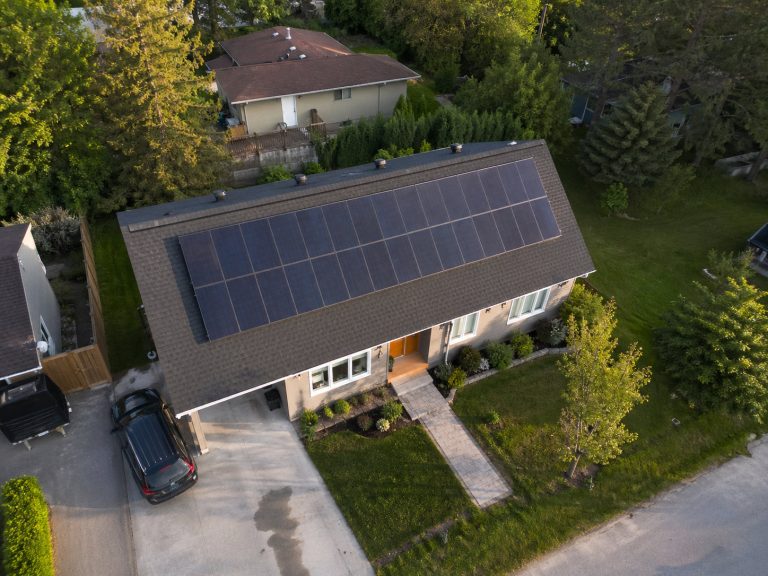
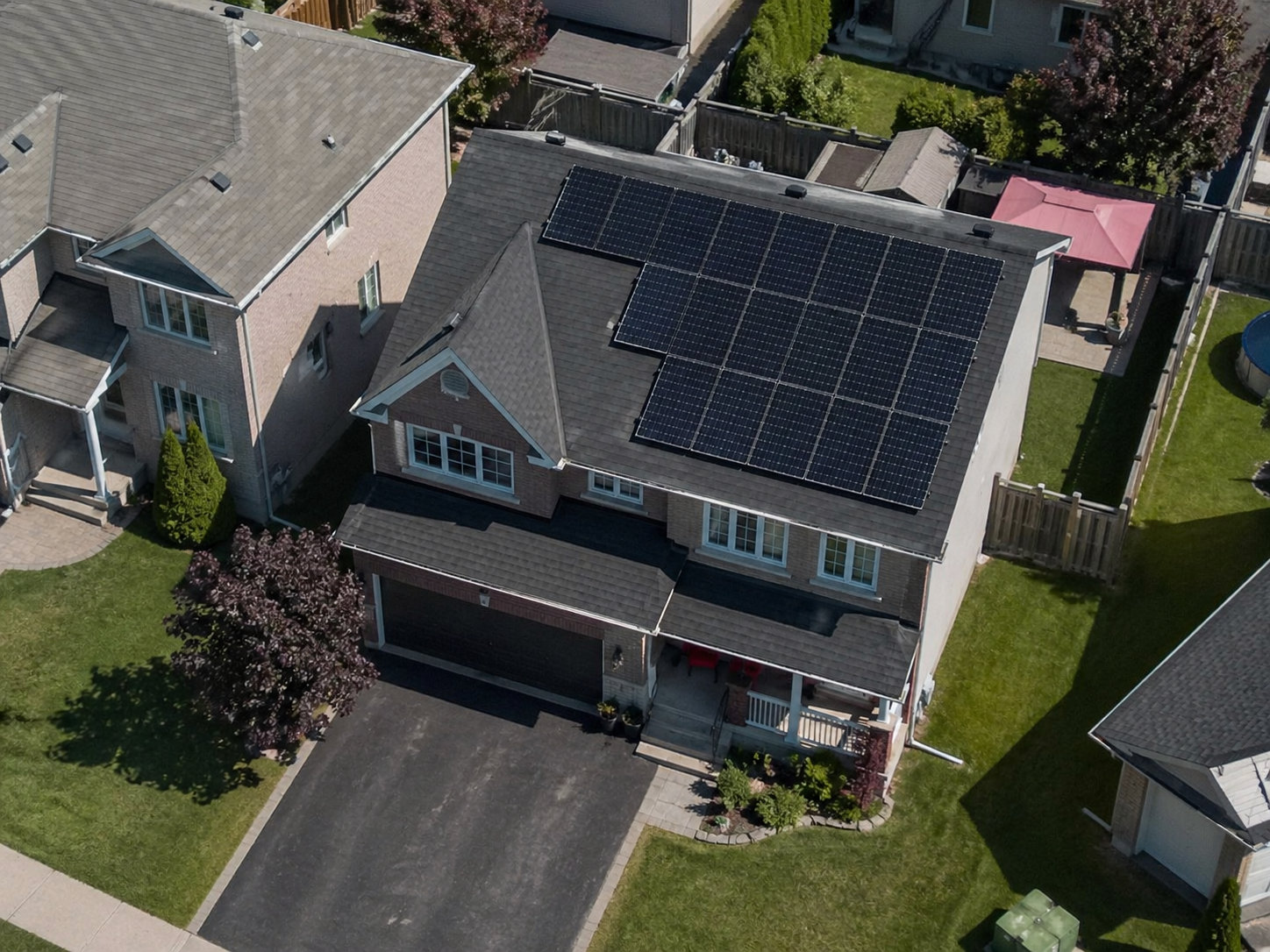
On pitched roofs, solar panels are usually mounted parallel to the roof surface. That is the normal flush-mounted approach. It is common because it is simpler, cleaner, and usually less exposed than a raised tilt structure.
If the roof pitch is already in a productive range, changing the angle may not be worth it. A 6/12 roof at about 26.6° or an 8/12 roof at about 33.7° may be close enough, depending on latitude and direction.
When Tilt Racks Help
Tilt racks on pitched roofs are not the default answer. They may be worth reviewing when the roof is very shallow, the roof direction is strong, and the modeled production gain is large enough to justify the extra design complexity.
The gain should be shown in annual kWh. If a tilt rack only adds a small amount of production, it may not be worth the added hardware, visual impact, wind exposure, or layout limitations.
Tilt Racks Create Tradeoffs
Raised tilt systems can create practical tradeoffs: more visible panels, more wind exposure, tighter layout options, and more complicated roof attachment details. Those are installation concerns, but they affect efficiency because they can change panel count and system layout.
For quote comparison, ask the contractor a direct question: what is the modeled annual kWh difference between flush mounting and tilting the panels on this roof face? If that comparison is missing, the recommendation is weak.
Flush Mounting Is Often Best
For many pitched roofs, flush mounting is the best balance. It may not squeeze out the theoretical maximum from each panel, but it often gives a strong total result with fewer compromises.
A clean flush-mounted array on a sunny roof plane can easily be the better real-world design compared with a complicated tilted layout that reduces panel count or creates awkward shade patterns.
Biggest Roof Angle Mistakes
Chasing Perfect Angle, Ignoring Shade
This is one of the most common bad decisions. Someone worries about being 5° or 10° away from the ideal angle but ignores shade from trees, chimneys, dormers, or nearby buildings.
The financial damage is not usually a one-time bill. It is years of lower production. If the savings estimate was built on optimistic output, that lost kWh stretches the payback period.
Tilting So High Fewer Panels Fit
On flat roofs, a steep tilt can look better at first. Then the row spacing gets added, and the layout loses panels.
That can be a bad trade. A lower-tilt layout with more modules may produce more total energy than a high-tilt layout with fewer modules. Always compare total annual kWh.
Skipping Annual kWh Modeling
Angle charts are fine for rough screening. They are not enough for a final layout decision. Annual kWh modeling accounts for tilt, azimuth, location, system size, and shade assumptions.
- Ask for annual kWh, not only system size in kW.
- Ask what tilt and azimuth values were used.
- Ask whether shade was modeled or only guessed.
- Ask whether flat-roof row shading was included.
- Ask for a modeled comparison if tilt racks are recommended.
Optimizing Only for Winter
Winter output matters, especially in colder regions or homes with electric heating. But most rooftop systems are judged across the full year.
A steep angle may help winter production and still be the wrong overall choice if it cuts summer output or reduces usable roof area. Winter optimization should be intentional, not accidental.
Ignoring Usable Sunlit Area
A perfect roof angle does not help much if the roof section is too small, shaded, chopped up, or facing the wrong way. Usable sunlit area is often the real limit.
A slightly imperfect angle on a large clean roof plane can beat a perfect angle on a cramped roof section. That is why roof layout review matters more than a single angle number.
Is Your Roof Angle Good Enough?
Step 1: Convert Roof Pitch
Start by converting the roof pitch into degrees. A 4/12 roof is about 18.4°, a 6/12 roof is about 26.6°, an 8/12 roof is about 33.7°, and a 10/12 roof is about 39.8°.
This avoids a basic but serious mistake. Roofing pitch and solar tilt are different measurements.
Step 2: Compare With Latitude
Compare the roof angle with your local latitude. If the numbers are close, the existing pitch may already be good enough. If they are far apart, the system may still work, but the production difference should be modeled.
Do not stop here. Latitude gives you a starting point, not a final answer.
Step 3: Check Roof Direction
Confirm which direction the roof face points. South is usually the strongest direction in the US, but southeast, southwest, east, and west can still be usable depending on shade and energy goals.
Direction should be measured as azimuth. A rough guess from the driveway is not good enough for a production estimate.
Step 4: Compare Tilt Loss
Look at the tilt loss next to the other roof losses. Is the angle really the weak point, or is shade doing more damage? Is a tilt rack gaining production, or is it reducing panel count?
If the gain is minor and the added complexity is real, the simpler design often wins. If the roof is flat or nearly flat, tilt may deserve more weight in the decision.
Step 5: Ask for kWh Modeling
The final decision should come from annual kWh modeling. A good quote should show expected production, not just panel count and equipment size.
If two contractors propose different angle strategies, compare the assumptions: tilt, azimuth, shade, panel count, and annual kWh. That is where the truth usually shows up.
Solar Roof Angle Criteria
Keep Existing Angle When Loss Is Minor
If the roof pitch is near the target tilt and the roof face has strong sun exposure, keeping the existing angle is usually sensible. On pitched roofs, flush mounting often gives the best balance of production and simplicity.
Use Tilt Racking for Flat Roofs
Flat roofs often benefit from tilt racking because the roof itself provides no useful panel angle. A typical design range is around 10° to 30°, but the final choice should be based on spacing, obstructions, wind exposure, and total annual kWh.
Avoid Racking That Reduces Panel Count
Do not approve a high-tilt design just because it sounds more optimized. If it reduces the number of panels or creates row shading, it may produce less energy overall.
Prioritize Highest Annual kWh
The best solar roof angle is the one that supports the best full layout. Sometimes that means flush-mounted panels on a pitched roof. Sometimes it means moderate tilt on a flat roof. Sometimes it means using more than one roof plane.
| Roof Condition | Likely Best Approach | What to Verify |
|---|---|---|
| Pitched roof near latitude tilt | Flush mount | Annual kWh, azimuth, shade |
| Very shallow pitched roof | Model flush vs. tilt racks | Production gain versus added complexity |
| Flat roof with open area | Tilted racking | Row spacing and wind exposure |
| Flat roof with many obstructions | Lower tilt or selective layout | Panel count, self-shading, usable area |
| Steep roof above about 40° | Model seasonal and annual output | Summer production and access limitations |
The best design is not the one that makes every panel look perfect by itself. It is the one that produces the most dependable annual energy from the real roof, with the fewest avoidable compromises.
FAQ
What Is the Best Roof Angle for Solar Panels?
A tilt near your local latitude is the usual starting point. It does not have to be exact. A roof within about 10° to 15° of that target can often perform well if direction and shade are favorable.
Is a 30° Roof Angle Good?
Yes. A 30° roof angle is often a strong solar pitch in many US locations. The final answer depends on roof direction, shade, and the modeled annual kWh, but 30° is generally a workable angle.
Is a Flat Roof Bad for Solar?
No. Flat roofs can work well because the installer can choose the panel tilt. The main limits are row spacing, self-shading, wind exposure, roof obstructions, and total panel count.
Should Panels Match the Roof Angle?
On pitched roofs, yes, panels usually follow the roof angle. Tilt racks only make sense when the modeled production gain is large enough to justify the added complexity.
How Much Output Does Wrong Angle Lose?
A modest tilt mismatch may only reduce annual production by a few percent, but there is no universal number. The loss depends on location, direction, shade, and layout. Annual kWh modeling is the reliable way to compare options.